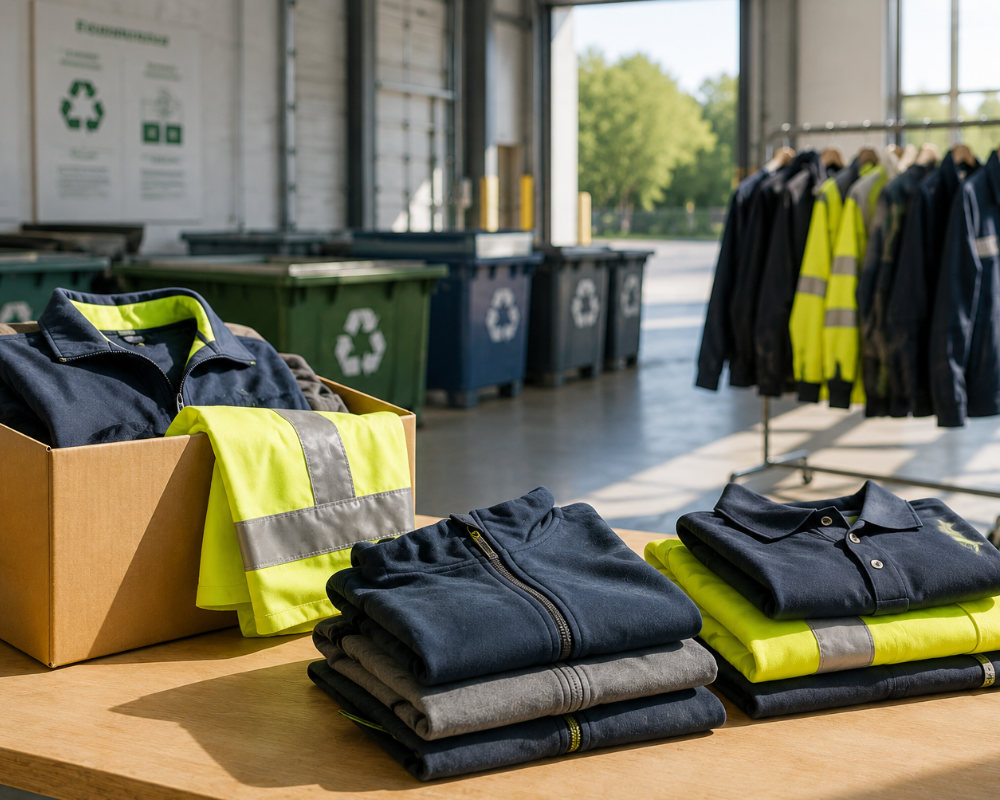
Every year, organisations generate significant volumes of unwanted workwear, uniforms, PPE and branded garments. Whether due to staff turnover, contract changes, rebranding programmes, company growth, changing health and safety requirements or normal wear and tear, businesses must eventually decide what happens to these items when they are no longer needed.
For many organisations, this challenge is often overlooked until stock begins to accumulate in warehouses, distribution centres, storage facilities or changing rooms. However, workwear disposal is no longer simply a waste management issue.
Businesses today are under increasing pressure to reduce waste, improve sustainability performance, demonstrate responsible environmental practices and protect their brand. At the same time, many workwear items carry logos, company branding, employee identifiers or sector-specific features that require careful handling.
The question is no longer simply how to dispose of old workwear. It is how to do so responsibly.
Understanding the options available can help organisations reduce waste, support sustainability objectives and minimise unnecessary risk.
Why Workwear Requires Special Consideration
Unlike ordinary clothing, workwear serves a specific purpose.
Many garments are designed to identify employees, represent a brand, provide protection or meet industry regulations. As a result, they often carry greater operational, reputational and security implications than everyday textiles.
Examples include:
- Branded uniforms
- Corporate clothing
- High-visibility garments
- PPE
- Healthcare uniforms
- Utility sector workwear
- Security uniforms
- Hospitality uniforms
- Transport uniforms
- Specialist protective clothing
When these garments reach the end of their useful life, organisations must consider more than simply removing them from site.
Questions often include:
- Can they be reused?
- Can they be repaired?
- Can they be recycled?
- Should they be destroyed?
- Do they contain sensitive branding?
- Could they be misused?
- How can they support sustainability objectives?
The answers will vary depending on the garments involved, their condition and the organisation’s priorities.
Option 1: Reuse
Where possible, reuse should be considered first.
Extending the life of existing garments is often the most resource-efficient outcome and aligns closely with circular economy principles.
Many businesses automatically replace workwear without fully exploring whether garments can continue to serve a purpose elsewhere within the organisation.
Internal reuse opportunities may include:
Reissuing Garments
Workwear returned by departing employees may still have significant remaining life.
After inspection and appropriate processing, some items may be suitable for reissue.
Redistributing Stock Between Sites
Different locations often experience varying levels of demand.
Excess inventory at one site may help avoid unnecessary purchasing elsewhere.
Retaining Contingency Stock
Maintaining a controlled reserve of reusable garments can reduce future procurement requirements.
Supporting Temporary Requirements
Reusable workwear can be useful for contractors, temporary workers or short-term projects.
Reuse not only reduces waste but can also deliver meaningful cost savings by maximising the value of existing assets.
However, organisations should always ensure garments remain fit for purpose and continue to meet operational and safety requirements.
Option 2: Repair and Redistribution
Not all workwear that appears worn out has reached the end of its life.
In many cases, garments can be repaired, refurbished or modified to extend usability.
This may include:
- Replacing zips
- Repairing seams
- Reinforcing high-wear areas
- Replacing fasteners
- Professional cleaning and refurbishment
For organisations managing large workwear fleets, repair programmes can significantly extend garment lifecycles while reducing textile waste.
Redistribution can also play an important role.
Garments that are no longer required in one department, region or business unit may still be perfectly suitable elsewhere.
A structured redistribution programme can:
- Reduce procurement costs
- Lower environmental impact
- Improve inventory efficiency
- Reduce unnecessary waste generation
As businesses increasingly focus on sustainability, extending garment life through repair and redistribution is becoming a valuable component of responsible workwear management.
Option 3: Recycling
Eventually, many garments reach a point where reuse is no longer practical.
When this happens, recycling should be considered wherever possible.
Textile recycling enables materials to remain in circulation rather than becoming waste.
Depending on the garment type and material composition, workwear may be processed into new textile products or recovered for alternative applications.
Potentially recyclable items include:
- Cotton garments
- Polyester workwear
- Mixed fibre textiles
- High-visibility clothing
- Corporate uniforms
- Certain PPE products
However, recycling workwear can be more complex than recycling ordinary clothing.
Several factors influence whether garments are suitable for recycling:
Material Composition
Some fibres are easier to process than others.
Complex blended materials may require specialist recycling solutions.
Contamination
Workwear exposed to chemicals, oils or hazardous substances may require additional handling procedures.
Branding
Visible logos and company identifiers may need to be managed before garments enter recycling streams.
End Market Requirements
Different recycling routes have varying material specifications and acceptance criteria.
Despite these challenges, recycling remains an important solution for organisations seeking to reduce textile waste and improve resource efficiency.
Option 4: Secure Destruction
There are situations where reuse and recycling may not be appropriate.
When workwear carries significant branding, presents security concerns or creates reputational risk, secure destruction may be the most suitable option.
Secure destruction ensures garments cannot be reused, resold or misappropriated.
This approach is particularly important for:
- Security uniforms
- Transport uniforms
- Utility sector workwear
- Healthcare garments
- Branded corporate clothing
- High-profile retail uniforms
- Garments carrying sensitive identifiers
Many organisations assume secure destruction conflicts with sustainability objectives.
In reality, responsible destruction processes can often support material recovery opportunities while ensuring garments cannot re-enter circulation in a recognisable form.
This allows businesses to maintain brand protection while continuing to prioritise environmental responsibility.
The key is ensuring destruction processes are transparent, traceable and supported by appropriate reporting and certification.
Common Mistakes Businesses Make
While many organisations have strong intentions when managing workwear, several common mistakes continue to occur.
Treating Workwear as General Waste
Workwear often contains recoverable value and may require specialist handling.
Simply disposing of garments alongside general waste can result in missed sustainability opportunities.
Failing to Consider Brand Protection
A uniform may appear obsolete internally but still carry significant value externally.
Improper disposal can create reputational and security risks.
Focusing Solely on Cost
Selecting the cheapest disposal route may lead to unintended consequences if sustainability, security or compliance considerations are overlooked.
Overlooking Data and Reporting
Many organisations struggle to demonstrate the environmental outcomes of their textile management programmes because reporting requirements were not considered from the outset.
Assuming Recycling Is Always the Best Solution
While recycling is often desirable, it is not automatically appropriate for every garment.
A balanced approach should consider security, condition, material composition and organisational objectives.
Building a Responsible Workwear Management Strategy
Rather than managing workwear on an ad-hoc basis, organisations should develop a structured strategy that supports both operational and sustainability goals.
A successful approach typically begins with understanding what workwear is being generated and why.
This involves reviewing:
- Uniform replacement programmes
- Employee turnover
- Procurement practices
- Inventory management
- Branding requirements
- Sustainability objectives
Once these factors are understood, businesses can develop a hierarchy of preferred outcomes.
For many organisations, this hierarchy may follow the following order:
- Reuse
- Repair
- Redistribution
- Recycling
- Secure destruction
Not every garment will follow the same pathway, but having a clear framework supports better decision-making and greater consistency.
Organisations should also seek visibility throughout the process.
Traceability, reporting and accountability are becoming increasingly important, particularly as sustainability reporting expectations continue to evolve.
The most effective workwear programmes balance environmental responsibility with practical business requirements.
The Growing Importance of Circularity
As organisations look beyond traditional waste management, circular economy principles are becoming increasingly relevant.
The objective is no longer simply to dispose of unwanted workwear but to maximise the value extracted from materials throughout their lifecycle.
This may involve:
- Extending garment life
- Recovering materials
- Reducing waste generation
- Supporting recycling initiatives
- Improving resource efficiency
By viewing workwear as a resource rather than waste, businesses can unlock environmental and operational benefits simultaneously.
This shift is helping organisations move away from linear disposal models towards more sustainable and resilient textile management strategies.
Old workwear does not automatically become waste.
Whether garments are reused, repaired, redistributed, recycled or securely destroyed, organisations have a range of options available to manage unwanted workwear responsibly.
The most appropriate solution will depend on factors such as garment condition, branding, security requirements, sustainability objectives and operational needs.
What remains consistent is the need for a considered approach.
Workwear represents more than a collection of garments. It reflects an organisation’s brand, operational standards and environmental responsibilities.
By developing a structured workwear management strategy, businesses can reduce waste, support sustainability goals, improve resource efficiency and protect their reputation long after a garment reaches the end of its working life.
For organisations seeking to improve both sustainability and brand protection, responsible workwear management should be viewed not as a disposal challenge, but as an opportunity to create long-term value from end-of-life textiles.